
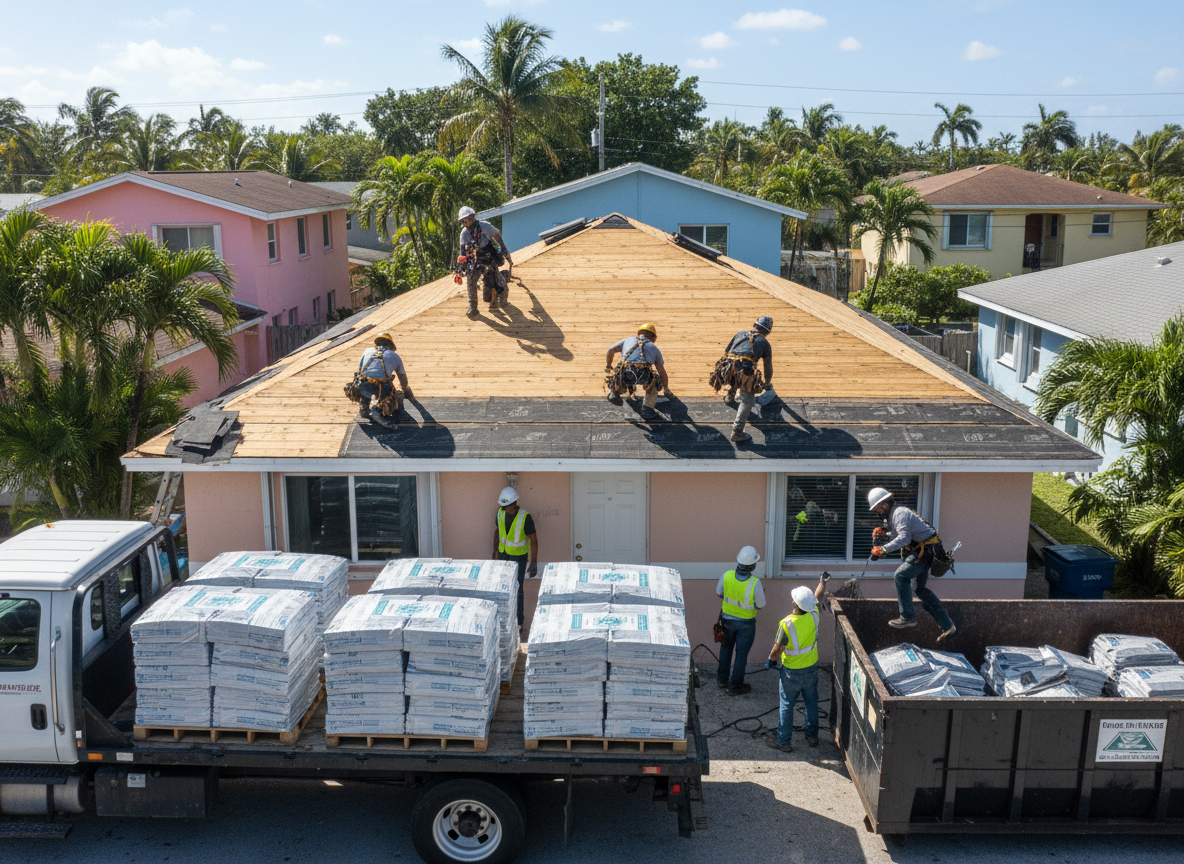
Many Miami homeowners start thinking about a new roof the day an insurance renewal letter arrives asking about roof age. Others start after the third leak repair in two years. Either way, the question is the same: what does a roof replacement in Miami FL actually involve, and what will it change? The answer covers more than shingles or tile. It includes the permit, the product approvals, the County's hurricane mitigation work and the cost of each, and you should see all of it before any work starts.
What a Good Roof Replacement Estimate Shows
A roof replacement in Miami-Dade is a code project, not just a material swap. The new roof has to pass permit inspections, use approved products and, on a site-built single-family home, include County hurricane mitigation work. A quote that only lists shingles or tile and labor leaves out part of the job.
A good estimate separates those parts. Look for the tear-off and disposal, the deck work, the underlayment or secondary water barrier, the roof covering, the flashing and the mitigation items, each as its own line. That lets you compare quotes honestly and see where the money goes. Whichever roof replacement company you choose in Miami, ask for that breakdown before you sign.
It is also fair to ask whether you need a replacement at all. If your roof was built under the 2007 Florida Building Code or later, Florida law lets a repair of 25% or more bring only the repaired portion up to current code. For some homeowners, that makes a section repair the better answer, and our roof leak and storm repair page covers that work. For a roof on a new build or addition, see new roof installation.
Keep insurance questions with your insurer. A roofer can describe the roof's condition and supply the permit and product paperwork that an inspector or insurer will ask about. Questions about what your policy pays for belong with your insurer, or with a public adjuster if you hire one.
Why the Timing of a Roof Replacement Matters in Miami
The building code is about to change. The Florida Building Code 9th Edition (2026) takes effect on December 31, 2026. Miami-Dade has said that applications submitted through its online portal after 4 PM on December 30, 2026 must comply with the 2026 edition. If you are planning a replacement, the code your permit is reviewed under depends on when it is submitted. Ask about it before you sign.
Hurricane season shapes the schedule. The Atlantic season runs from June 1 to November 30. A replacement started in the middle of the season is exposed to weather between tear-off and dry-in. Planning the job outside that window, or at least far from a forecast system, lowers the risk.
Insurance renewals have their own timeline. Florida insurers may not refuse to issue or renew a homeowner policy solely because a roof is under 15 years old. Once a roof reaches 15 years, the insurer must allow an inspection and cannot refuse coverage solely on age if the roof shows 5 or more years of useful life left. If your roof is near or past that line and the inspection is unlikely to go well, replacing before the renewal is often less stressful than replacing under pressure after a non-renewal notice.
What You Can Check on Any Replacement Estimate
This site does not publish ratings, review counts or years in business. Instead, here is what any Miami roof replacement estimate should give you, so you can check it yourself.
- The permit office. Each municipality in Miami-Dade has its own building official. The County handles permits only for unincorporated areas. The estimate should name the right office for your address.
- Product approval numbers. Miami-Dade requires approval for roofing products used in the County. Each product on the estimate should have one you can look up.
- The Owner's Notification. In the High-Velocity Hurricane Zone, a Section 1524 Owner's Notification Form is submitted with the roof permit application. It explains job-site conditions the owner must be told about.
- An itemized cost breakdown. Materials, labor, disposal, deck work and mitigation items listed separately.
- Matching contact details. Ours are the same on every page: Roof Repair Miami, 22510 SW 172nd Ct, Miami, FL 33170, (786) 892-8191.
Replacing a Roof to Keep or Lower Your Insurance
Here is the replacement scenario we did not find explained on any Miami roofing page we reviewed: a homeowner who is replacing the roof mainly because of insurance, and wants the new roof to count for as much as possible on the next policy.
Three pieces fit together here: one state rule, one state form and one County rule.
First, the roof-age rule. As above, an insurer cannot refuse or non-renew solely because a roof is under 15 years old, and for an older roof it must allow an inspection. A new roof resets that clock.
Second, the wind mitigation form. Wind-resistant roof features are recorded on the state's uniform mitigation verification form, OIR-B1-1802. A revised version of that form, Rev. 04/26, took effect April 1, 2026, and inspections on or after that date must use it.
Third, the County's mitigation work on a reroof. When an existing roof on a site-built single-family home in Miami-Dade is replaced, two mitigation items are always required: roof sheathing attachment to code and a secondary water barrier for shingle, wood shake and metal panel roofs. Roof-to-wall connections are a third item, required only for homes with an insured value (or, if uninsured, a just value) of $300,000 or more, and only up to about 15% of the reroof cost (F.S. 553.844).
Put together, the replacement is the moment to install several features the mitigation form looks at, while the roof is open. Here is how a homeowner can make the most of it:
- Review your current wind mitigation report, if you have one, to see which features are already credited.
- Ask for the County-required mitigation items to be priced separately, and ask whether the roof-to-wall requirement applies to your home and how its 15% limit was worked out.
- Ask which items on the estimate relate to features recorded on the mitigation form.
- After final inspection, keep the permit, product approvals and photos together. A wind mitigation inspector will ask for them.
Then call your insurer. Ask how they apply mitigation discounts and what they need from you to apply them after the new roof passes final inspection.
What a Miami Roof Replacement Includes
Tear-Off and Deck Inspection
Tear-off is the removal of the existing roof covering and underlayment down to the wood deck. It is the only point in a roof's life when the whole deck can be seen and checked.
Fix the deck while it is open
Deck problems get fixed now instead of under a new roof. Soft, rotted or delaminated sheets found during tear-off are replaced before anything goes on top, which protects the money you are spending on the new covering.
Settling the final price
This decides the final scope and price. Deck replacement cannot be known exactly until the old roof is off, so your estimate should state how damaged decking will be priced if it is found.
Compare per-sheet deck pricing
Ask every roofer how they price deck replacement per sheet, and compare that line, not just the total.
Roof Sheathing Attachment
Sheathing attachment is how the deck boards are fastened to the roof framing. In a hurricane, the deck is what holds the roof together, and its fastening decides whether panels stay on when wind pulls upward.
In Miami-Dade, County hurricane mitigation rules require roof sheathing attachment to meet the Florida Building Code when an existing roof on a site-built single-family home is replaced. It is required on every such reroof and is not limited by the 15% cost test, which applies only to roof-to-wall connections.
A stronger deck, and a mitigation credit
Proper attachment pays off twice. It lowers the chance of losing the deck in a storm, and it is one of the features recorded on the state's wind mitigation form.
How the deck is re-fastened
This decides how the deck is re-fastened.
Ask for photos before it is covered
Ask that the re-fastening be photographed before the underlayment covers it.
Underlayment and Secondary Water Barrier
Underlayment is the membrane laid over the deck under the finished roof. A secondary water barrier is the protection that keeps water out of the house if the roof covering is blown off.
Miami-Dade's HVHZ code sets accepted underlayment methods for shingle and metal roofs, such as a self-adhered membrane applied directly to the deck, taped or sealed deck joints, or two layers of nailable underlayment. On a reroof, County mitigation calls for a secondary water barrier on shingle, wood shake and metal panel roofs, and treats tile roofs with an approved underlayment system as compliant.
Protection when the covering fails
This layer is your protection when the covering fails.
Matching the method to your roof
This decides which method fits your roof type.
Ask for the method by name
Ask which underlayment method your estimate uses, by name.
Roof-to-Wall Connections
Roof-to-wall connections are the metal straps, clips or other connectors that tie the roof framing to the walls below. In high wind, they resist the uplift that tries to lift the whole roof structure off the house.
Roof-to-wall connections are required on a reroof of a site-built single-family home only when the home's insured value (or, if uninsured, its just value) is $300,000 or more, and only where they can be completed for about 15% of the reroof cost (F.S. 553.844). The connections are also among the features the state wind mitigation form records.
Why the frame matters
The benefit is structural. A strong covering on a weakly connected roof frame is still a weak roof.
Spending the mitigation budget
This decides whether connections are required for your home and which ones are reachable during the reroof.
Ask what can be reached and documented
Ask which connections can be reached from the roof side and how they will be documented.
Choosing Shingle, Tile or Metal
The roof covering is the finished layer: asphalt shingle, tile or metal. Each one has its own approval, attachment and underlayment requirements in Miami-Dade's HVHZ code, and each permit application is reviewed by system type.
Weight, cost and repairs
The choice comes down to weight, cost and repair pattern. Tile is heavy and needs the structure to carry it. Shingle is lighter and usually simpler to repair. Metal relies on its fasteners, clips and seams.
Which system fits your house
This decides which system fits your house, budget and plans for the home. Product approval applies to every option.
Check the approval for the exact product
Before choosing, ask for the product approval documents for the exact product being quoted, not just the brand, and compare what each requires underneath.
What an Itemized Estimate Should List
A replacement estimate that shows one total tells you the price but not the job. Each line below should appear separately, so you can compare quotes on the same scope. No prices are shown here; what matters is that every line is there.
- Tear-off and disposal. Removal of the existing covering and underlayment down to the deck, and how debris leaves the site.
- Deck repair, per sheet. How damaged decking found during tear-off will be priced, per sheet, since the amount is not known until the old roof is off.
- Underlayment method. The method by name: self-adhered membrane on the deck, taped or sealed deck joints with underlayment, or two layers of nailable underlayment, as the HVHZ code allows for the covering.
- Roof covering. The exact shingle, tile or metal product and its Miami-Dade product approval.
- Flashing and edge metal. Wall, valley and penetration flashing and edge metal, listed rather than assumed.
- County mitigation items. Roof sheathing attachment and a secondary water barrier where required, plus roof-to-wall connections if your home meets the $300,000 value test, with the 15% calculation shown for the connections.
- Permit and inspections. The permit office for your address, the roofing permit application, the Owner's Notification Form in the HVHZ, and the inspections.
If a line is missing, ask for it before you sign. Two estimates with different lines are not quotes for the same roof. If only part of the roof is damaged, compare the estimate with a section repair first.
Talk About a Roof Replacement in Miami
Call Roof Repair Miami at (786) 892-8191 to talk about replacing your roof. Ask about the permit office for your address, the product approvals for each material, how the County mitigation items are priced, and an itemized written estimate. Ask, too, whether a section repair under the 25% rule would serve you better. Our office is at 22510 SW 172nd Ct, Miami, FL 33170.