
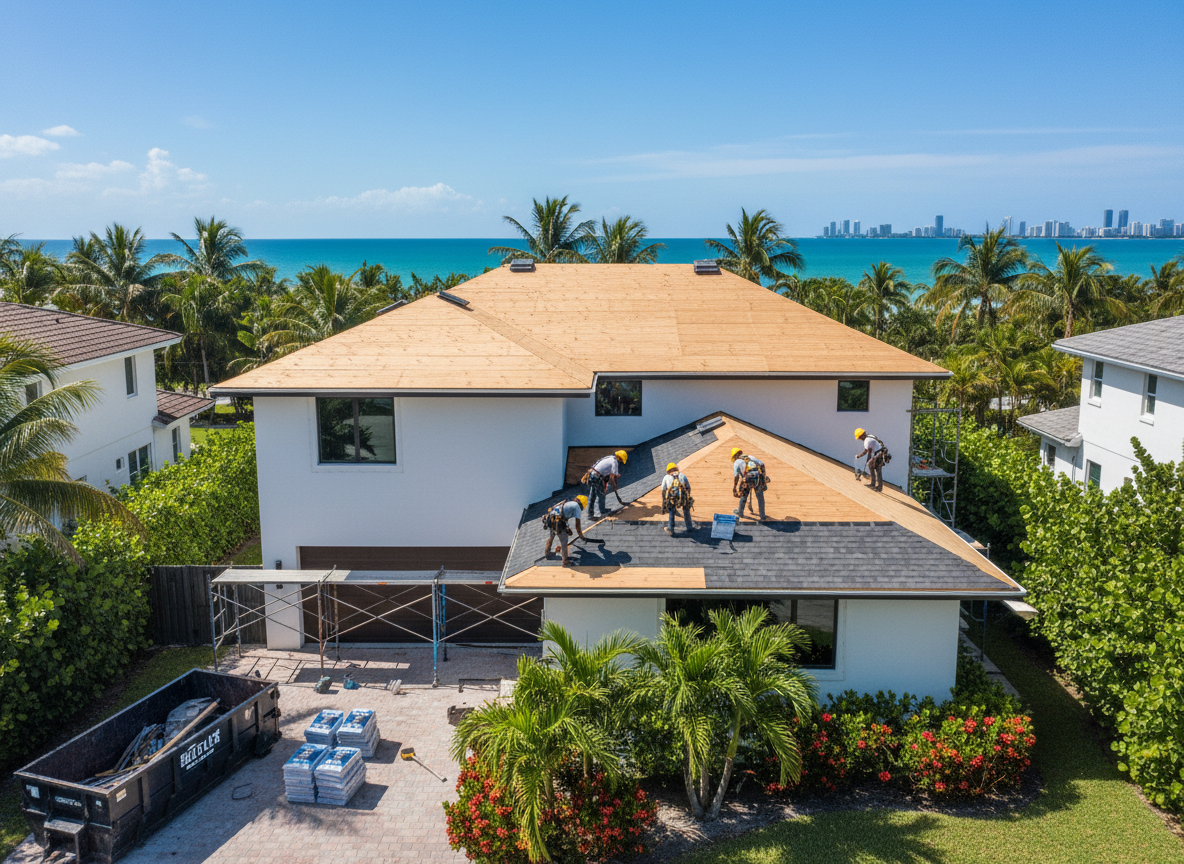
A roof on a new build, a room addition or a house being rebuilt after storm damage is the one roof on a Miami-Dade property with no history to work from. There is no old permit to check and no previous system to match. Every product, fastener and layer has to be chosen and approved from scratch for the High-Velocity Hurricane Zone. A new roof installation in Miami succeeds or stalls on that approval and inspection path, so it pays to understand it before the first sheet of decking goes up.
What to Expect From a New Roof Installer
A new roof in Miami-Dade gets reviewed twice: once on paper when the permit is applied for, and again on the roof during inspections. A roof that is installed well but documented poorly can still stall at inspection. Plan for both.
A good estimate lists each layer of the new roof as its own line: deck preparation, underlayment method, the roof covering, flashing and edge metal. Each roofing product should appear with its product approval, so the permit reviewer and the inspector can match what is on the roof to what was approved.
Expect the choices to be explained, not just priced. Tile, shingle and metal each carry different approval and attachment requirements in the HVHZ, and the permit application treats them as different systems. Before you choose, ask how each one affects the paperwork, the inspections and the cost.
Our contact details are the same on every page: Roof Repair Miami, 22510 SW 172nd Ct, Miami, FL 33170, (786) 892-8191.
Why the Next Few Months Matter for a New Roof Installation in Miami
The Florida Building Code is changing. The 9th Edition (2026) takes effect on December 31, 2026. Miami-Dade has said that applications submitted through its online portal after 4 PM on December 30, 2026 must comply with the 2026 edition. For a new roof that has not yet been permitted, the submission date decides which code edition your design is reviewed under. If your project is close to that date, plan the application with that in mind.
Weather is the other clock. The Atlantic hurricane season runs from June 1 to November 30. A new roof is most exposed between deck installation and dry-in, when the underlayment has not yet sealed the structure. Scheduling that stretch away from an active forecast protects the framing and interior from rain.
The season also runs late. Hurricane Wilma made landfall in southwest Florida on October 24, 2005, and Miami International Airport recorded a 92 mph gust. An October schedule is not automatically a safe one.
South Miami-Dade knows what a direct hit means. Hurricane Andrew made landfall before dawn on August 24, 1992 at Fender Point, just east-northeast of Homestead Air Force Base, as a Category 5 with 165 mph sustained winds. The National Weather Service records about 49,000 homes destroyed and about 108,000 damaged. A new roof here is designed for the storm the area has already had, and every approval and inspection on this page exists to make sure it was built that way.
What You Can Verify on a New Roof Installation
This site does not post review counts, ratings or years in business. What it can give you is a checklist you can use with any installer.
- The right permit office. Each municipality in Miami-Dade has its own building official. The County issues permits only for unincorporated areas. Your installer should name the right office for your address.
- The Uniform Roofing Permit Application. Miami-Dade requires it for all roofing permits handled by the County.
- Product approvals. Miami-Dade requires approval for roofing products used in the County, and residents are told to look for the "Miami-Dade County Product Approved" mark. Every product on your estimate should have an approval you can look up.
- The Owner's Notification Form. In the HVHZ, a Section 1524 Owner's Notification Form is submitted with the roof permit application.
Getting a New Roof Through Miami-Dade Approval
New construction roofs are the part of this market that the Miami roofing pages we reviewed treat as an afterthought. Most fold new installation into replacement. They are different jobs. A replacement inherits a structure, a permit history and, on a site-built single-family home, County mitigation retrofits such as deck attachment and a secondary water barrier. A new roof inherits none of that. It is designed, approved and inspected as new work. If you are replacing an existing roof, our roof replacement page covers that path instead.
Here is the path a new roof in Miami-Dade follows, and what you can do at each step.
- Confirm the jurisdiction. Find out whether the property is in unincorporated Miami-Dade or in one of its municipalities. That decides which office reviews the roof and which forms it uses. In unincorporated areas the County's roofing e-permitting covers the address.
- Choose the roof system. Tile, shingle and metal are reviewed as separate systems with their own approval and attachment requirements. Make this choice before the permit is drawn up, not after.
- Assemble product approvals. Every product in the system, from underlayment to covering, needs approval for use in the County. Ask your installer for the list.
- Submit the application. The Uniform Roofing Permit Application goes to the County for unincorporated addresses, along with the Owner's Notification Form required in the HVHZ. Municipalities use their own process.
- Watch the code-edition date. Submissions through the County portal after 4 PM on December 30, 2026 are reviewed under the 2026 code.
- Keep the records. Store the permit, approvals and inspection results together. A future buyer, insurer or wind mitigation inspector will ask for them.
The Parts of a New Roof in Miami-Dade
The Roof Deck
The roof deck is the structural layer of boards or panels fastened to the rafters or trusses. Everything else on the roof is attached to it, so its fastening is what keeps the roof together when wind pulls upward.
Get the deck right first
On a new roof, the deck is the cheapest it will ever be to do well. Once the covering is on, correcting deck fastening means taking the roof apart.
Attachment and materials
This decides the attachment schedule and the materials used, which the Florida Building Code sets and the inspector checks. The deck is also one of the features the state's wind mitigation form records.
Photograph the fastening
Ask your installer to photograph the deck fastening before underlayment goes on, and keep those photos with your permit.
Underlayment in the High-Velocity Hurricane Zone
Underlayment is the waterproof membrane laid on the deck beneath the roof covering. On a new roof it is the first full layer of protection, and in a storm it is often the last thing keeping water out.
Miami-Dade's HVHZ code sets accepted underlayment methods for asphalt shingle, metal and several other coverings: a self-adhered membrane applied directly to the deck, taped or sealed deck joints with underlayment above, or two layers of nailable underlayment. Tile roofs use approved underlayment systems of their own.
Long-term leak protection
The payoff is long-term leak protection.
Choosing a method
This decides which method suits your covering and budget.
Confirm it on the permit
Ask your installer which method they are using, by name, and confirm it appears on the permit documents.
Metal Roofing
A metal roof is a covering of metal panels joined at seams and attached with fasteners or concealed clips, with trim and flashing at edges and penetrations. In the HVHZ, metal panels follow the County's approval and underlayment rules like any other covering.
Attachment decides performance
Metal performs according to how the system is attached. The panels themselves rarely fail first. Fasteners, clips and seams are where performance is won or lost.
Panel type and attachment
This decides panel type and attachment method, which must match the product approval. Miami-Dade publishes separate e-permitting guidelines for metal roofs, so the paperwork is specific to the system.
Match the approval to the estimate
Ask for the approval document for the exact panel and attachment system being quoted, and check that it matches the estimate.
Tile Roofing
A tile roof is a covering of concrete or clay tiles set over an approved underlayment system, attached mechanically or with mortar or adhesive. The tiles shed most of the water and handle the sun. The underlayment underneath does the final waterproofing.
A heavy, durable covering
Tile gives a heavy, durable covering, but that weight has to be carried by the structure and accounted for in the design. Mechanically fastened and mortar or adhesive set tile are different attachment methods, and the one on your roof must be the one the approval covers.
Tile type and attachment
This decides tile type and attachment method, both of which must match the product approval.
Check the structure early
If you are considering tile, confirm early that the roof structure has been designed for its weight, before the permit drawings are finished.
Shingle Roofing
An asphalt shingle roof is a covering of overlapping shingles nailed over underlayment on the deck. It is lighter than tile, and in the HVHZ it follows the County's specific underlayment methods for shingle roofs.
Lighter, simpler to repair
Shingle offers simpler future repairs, since damaged shingles can be replaced in small areas, and less weight on the structure than tile. Compare installed cost on itemized estimates.
Product and underlayment
This decides the shingle product, which must carry approval for use in the County, and the underlayment method beneath it.
Check the nailing pattern
Ask for the product approval for the exact shingle line being quoted and confirm the nailing pattern on the approval matches what the crew will install before work starts.
Talk About a New Roof Installation in Miami
Call Roof Repair Miami at (786) 892-8191 to talk about a new roof for a new build, addition or rebuild. Ask about the permit office for your address, how tile, shingle and metal compare for your structure, the product approvals for each material and an itemized written estimate. Our office is at 22510 SW 172nd Ct, Miami, FL 33170.